About McBob's
Milwaukee famous since 1986! Curious about our story? We'd love to tell you more.
Most people know us for our corned beef and famous big tacos--but there's so much more!
On July 7, 1986, Robert McRoberts applied for a permit to operate a tavern in the retail space at 4919 W. North Ave.
A few weeks later, on Aug. 1 – the date that current owner Katy Klinnert regards as the official anniversary day – McRoberts received that permit from the City of Milwaukee and McBob’s was officially born.
Now, McBob’s, by now a Washington Heights and Uptown Crossing landmark is celebrating its 40th anniversary.
A former personal chef, and a professional musician, Klinnert bought McBob’s with partner Sara McConville (who is no longer in the business) two years ago.
But she didn’t really plan to.
After her personal chef service suffered a devastating loss in an Oak Creek fire, Klinnert moved to a space on West North Avenue (home back then to the now-closed Whiskey Haze) that was owned by McBob’s previous owners Christine McRoberts and Steve Schmich.
“We moved in there and shortly afterward they told us they'd sold both businesses,” Klinnert recalls. “I had finally thought we were kind of settled. So I talked to the guy who was going to be the new owner and I said, ‘Look, we've been through hell and high water just trying to make a living. Both of us are single parents and if you so much as changed the name of this place, our license is null and void. We have to go through the whole process again. It's about $1,200. And so I just need to know where you're at. We would love to stay, but if you have qualms about that, I need to know right now.’ And he said, ‘No, let's work it out’.”
But, then, the deal with that buyer didn’t come to fruition.
“I opened my big dumb mouth and said, ‘Oh, maybe this is something that we would be interested in.’ And (they) turned around, were like, ‘Really? Let's talk’."
Et, voila! A few months later the sale was complete and McBob’s had new owners, adding Klinnert’s name to a long list of folks who have run everything from delicatessens to taverns to supper clubs in this small building.
A little history
The history of the McBob’s building dates to 1922, when on Dec. 16, William H. Wille pulled a permit to construct a store with two flats on the site.
The structure was completed the following May and operated as a delicatessen owned by Wille and his wife Emmie.
William Herman Wille was born in Germany in 1880 and arrived in the U.S. three years later. He worked as a streetcar and interurban train conductor at least as early as 1906. It was a job he still held in 1920.
Wille, who married Milwaukee-born Emma Maass in 1906, became a citizen in 1921.
While the 1924 city directory records Wille as operating the delicatessen, the 1927 book lists him only as a conductor, which makes one wonder if he kept his transit job the entire time or if the delicatessen was a brief diversion before he returned to the streetcars.
Of course, it is also possible that Emmie ran the delicatessen, which just happened to be in her husband’s name (being the 1920s and all).
Either way, by 1927, the delicatessen was run by Conrad Steger and a Samuel Habush was living above it.
But that appears to have been short-lived as by 1929, the Home Bakery & Confectioners sought an occupancy permit in May and the John Schlintz Home Bakery filed for another one in October.
According to the 1930 city directory, Arlene Tetzlaff ran the bakery, and the next two years the directory said James H. Neuens was the baker.
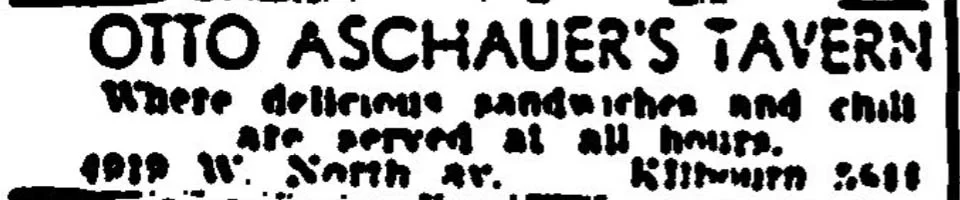
By 1933, with the arrival of Repeal, the space was taken over by tavernkeepers Otto and Margaret Aschauer, who were renting the space from B.F. Kuehlhorn, at least initially.
Otto Aschauer's tavern - 1934 ad:
The Aschauers had previously run an illicit saloon nearby at 3822 W. Lisbon Ave. where a year before the move Otto was sentenced to six months for bootlegging and a case against Margaret was dropped.
Otto had been born in Germany in 1881 and arrived in Milwaukee with his family when he was still an infant. In 1902 he married Margaret Madden, who was four years his senior. In addition to working at the well-known Fritz Gust restaurant for five years and owning his own tavern for his final five years, Otto Aschauer also worked as a steward at the Deutscher Club for 12 years and at the Oconomowoc Club for seven.
Apparently, with Otto now free – and free to sell booze legally – the Aschauers were running the first bar in the building. At least until November 1936, when at the age of 55, Otto died of a heart ailment.
Margaret stayed on briefly afterward, but not for long. In October 1939, the building was for sale for $18,500.
By 1940 Michael Zimmermann had moved his tavern into the building from its nearby previous location at 4500 W. North Ave.
When in May 1948, Zimmermann decided to list the building for sale, the ads noted that he was retiring from the tavern business. The property was described as a “modern fireproof building, clean as a whistle” with a “large streamlined barroom, kitchen and office-study” on the first floor and a “beautiful six-room apartment” above. Included were the equipment, fixtures and bar stock.
By 1951, a real Milwaukee entertainment king of his era arrived on the scene.
The Wally Behl era
Wally Behl was a pianist, organist and accordionist known not only for giving lessons and demonstrating instruments at local music shops, but also for his high-profile gigs, like the Monday night Jamborees at Earl Steinhart’s Royal Bar at 3229 W. North Ave.
McBob's Wally Behl's
Wally Behl ad, 1951.
Behl also was a familiar figure on local radio, playing on WEMP and WFOX. For four years he was the house organist for WTMJ, where he also had his own spot on Saturdays at 5:15 p.m.
But Behl was also a restaurateur and when he opened in the old Zimmermann’s Bar, he advertised it in the Journal.
“Wally Behl, your television organist is now managing his own cocktail bar. Delicious food. Music as you like it.”
He stayed until 1955, when he moved a bit west to take over 6030 W. North Ave. (now home to Ca’ Lucchenzo) and opened Wally Behl’s Tosa Chateau, “going great guns” in “a spot that proved a jinx to many operators before him,” according to one newspaper mention.
In 1960, he sold that place to Jake Replogle, who opened the long-running and popular Jake’s there, and opened Wally Behl’s Redwood at 21445 W. Capitol Dr. in Brookfield. In 1967, he sold THAT place to Replogle for another Jake’s and opened a new Wally Behl’s in Pewaukee.
Meanwhile, back on 49th and North, Sal Verona opened Verona’s Cocktail Bar and ran it for barely a year before moving on to take over the Ol’ South on Lisbon Avenue by January 1958.
The Crest supper club
That made way for Roland Baesemann to come in an open The Crest at 4919 W. North Ave.
Not just a cocktail lounge, The Crest was also known for fine food, and boasted of being the home of the onion ring and open-faced tenderloin.
Baesemann was an interesting fellow who had operated a trio of popular restaurants in the area, the first being the Zebra Restaurant on 38th and Lisbon. Then came The Crest.
Finally, in 1969, he and two others bought the Range Line Inn in one of the oldest buildings in Ozaukee County, on the corner of Range Line and Mequon Roads. They redecorated it and made it into one of the most popular restaurants around.
Interestingly – presumably by someone who'd never heard of tapas – Baesemann was credited as the “creator of meals made only from hors d’oeuvres.”
After his death in 1972 at the age of 62, his wife Ruth told an obit writer, “He used to listen to people complain when their food arrived, saying that they had eaten too many hors d’oeuvres and just couldn’t enjoy their meals. That’s when he decided to make a meal out of hors d’oeuvres.”
She said that he would use caviar, lobster and other delicacies to help patrons create a meal out of a dozen or half-dozen appetizers.
Baesemann sold The Crest in 1962 to the Milwaukee-born Alfred Lemke, who had been in the tavern business since 1941. Lemke added his name to the place, calling it Lemke’s Crest until 1971 when he sold it and opened Lemke’s On National at 11501 W. National Ave.
McBob's The Crest
G. L. Campbell took over The Crest, which was advertising steaks and seafood, Friday fish fry with potato pancakes, corned beef and cabbage, sauerbraten, roast duck, baked kessler rippchen and pork shanks and sauerkraut.
It’s hard to tell when The Crest name ceased being used, but the place was owned by G.K. Enterprises in 1973. But it seemed to have been quickly tanked by debt and either that same year or in 1974 Marc Wagner arrived to open Polo’s Pub, which appears to have been more neighborhood bar than a cocktail lounge.
In 1976, a newspaper reporter talked to Wagner about replacing Schlitz on tap with Pabst about six months after opening.
“The kids just all asked for Pabst,” he said. “Pabst, Pabst, Pabst. If I put Schlitz on the Pabst line, I don’t think half the people here would know. I think the best beer we’ve got is Miller Lite or Olympia.”
Wagner said that Pabst was besting his two other tap beers – Lite and Olympia – by seven-to-one each. In bottles, he sold 15 PBRs for every Schlitz.
In 1977, well-known tavernkeeper Brett Mazzone (he ran Brett’s on the lower East Side before it became Points East Pub) opened Brett’s Bulldog Inn which seems to have lasted for about three years.
Gary Weigel then arrived on the scene and also stayed for about three years, until 1986, when on July 7, Robert B. McRoberts was issued a permit for his new place, McBob’s, which he initially opened with his brother-in-law Michael Wanta.
McBob’s is born
McBob's
The corner bar (well, on the corner of an alley) had a small grill and a Celtic theme celebrating McRoberts’ Scottish and Irish roots.
In 1989, Brian Hunter, who had worked at McBob’s for four years joined as another partner. A decade later McRoberts’ sister Christine – who had been working at the place for a few years – and her husband Robert Rubner (who passed away in 2011) bought McBob’s and amped up the Celtic vibes.
According to Klinnert, “an unnamed Italian customer made the suggestion that made all the difference. He suggested that McBob’s should be serving corned beef, and that the secret of great corned beef was long, slow cooking. They tried it as a special, and it was so popular they ended up offering it every day.”
Thus did corned beef make its return, perhaps for the first time since The Crest era.
The new owners added a full kitchen in 2000 and expanded the dining room seven years later. In 2020, the interior was remodeled.
Then, McRoberts decided it was time to retire, and Klinnert arrived on the scene.
McBob’s today
The McBob’s building, Klinnert says, was showing its age when she arrived.
“The upstairs had water damage,” she recalls. “We had to put in air conditioning and heat. There was no HVAC up there at all. The plumbing had been ripped out so everything had to be put back into place.”
The building needed a new roof and the restaurant needed air conditioning.
“Nobody wants to sit in a restaurant with no air conditioning,” Klinnert says. “We chose a fresh coat of paint, lightened it up a little bit, and chose to update the lighting fixtures. Those actually came with us from Whiskey Haze and they were beautiful.
“(The previous owners) had done some renovation during COVID when the funds were coming for restaurant owners. So the bar got redone and the floors, which is great.”
Business – challenging in the post-COVID era, especially with inflation causing costs to rise – is on the upswing, Klinnert says.
McBob's patio
“People are not eating out as much,” she says. “As the generations change, they're not drinking as much, which I can only respect. It's hard to be mad about that, but as a business person who relies on that, it's challenging.
“So right now about 60 percent of our business is takeout and delivery. We do a ton of Door Dash. We're trying to get people comfortable coming back in, enjoying the patio, enjoying the dining room, and being comfortable inside again.”
The place looks great, inside and out. The dining room is bright and clean and the patio, adorned with colorful dangling flowers is an intimate and beautiful little sanctuary.
Though the menu has been slimmed down and undergone a few changes, the corned beef is unaltered, Klinnert vows.
“When I told my accountant I was buying this place, he said, ‘I need you to promise me that you're not going to change the corned beef or I will register your LLC as I Promise Not to Change the Corned Beef LLC’," Klinnert says. “I was like, ‘Yes, yes, I promise.’ So the corned beef has not changed.
“It's the same person cooking the corned beef, the same product that comes in. Our biggest change there was I made the decision to make it more of a build-your-own because corned beef has a really interesting history. If you go to Ireland, you won't find it unless you go to an American restaurant, but the Jewish community has their own version of corned beef, the Black community has their own version.
“We see all of those people come here and so we just give them the options. The meat is the same but the accoutrements can vary. People get to customize it.”
McBob's
Klinnert says that her customers are a mix of long-time, devoted regulars and newer folks.
“I think it's 50/50,” she says. “There are definitely people who came and introduced themselves right away and said, ‘I've been coming here forever. I'm sticking with you. We've got your back’.
“We're trending a little bit younger and yet we're keeping a lot of the older clientele who have been coming for a long time and I love that. I love getting to meet people. I've worked really, really hard to be open about how welcoming we are.”